A few days ago Paolo Dozzo, Sales Manager at Claypaky, read my post about Elita Ouverture and invited me to visit the company. That is how I became one of the first people to see a technical demo of the new Claypaky A.Leda B-EYE.
Until a few days earlier we all thought we had reached the end of the road. “Everything has been invented: pan, tilt, colour mixing, iris, gobos, beam… there’s nothing left.” But, as often happens, a flash of inspiration (sometimes unwanted, sometimes born by mistake, sometimes the result of plain determination) opens new horizons, pushes the limits a little further and reminds us that there are still other dimensions to explore.
That is exactly what happened with Claypaky’s new invention. While the rumour was “spot, wash, beam: it has all been done”, here comes the surprise. It comes from new technologies that improve what already exists, but also from an insight so simple it is brilliant: take a special lens, change the angle of incidence, perhaps through a simple rotation system, and…
Claypaky is a big company that still builds carefully crafted products. Each fixture is assembled by hand, piece by piece, by highly skilled workers; a team of “electronics artists” has the freedom to invent; and every single unit off the line is quality tested. The B-EYE is the evolution of the A.Leda K5, K10 and K20 LED wash, launched about two years ago.
Where it starts: the A.Leda wash
To understand what is new in the B-EYE, let’s take a step back to the “old” A.Leda K20, K10 and K5, with the help of Marco Zucchinali, Sales Support Engineer at Claypaky.

LED sources
The A.Leda uses 15 W LEDs, today the most advanced and widely used standard.
Optics
Claypaky chose a more efficient lens, with a light efficiency of 80%, designed specifically for a wash.
Zoom
The A.Leda zoom uses a dual lens, one positive and one negative, instead of two positive lenses. With the two lenses close together you get a narrow beam at 80% efficiency. With the lenses apart, efficiency drops to about 65% but the beam is far more even, with a smooth, linear fall-off instead of a steep one. It was never meant to be a beam, as the market was asking at the time, but a highly evolved wash.
Pixel mapping
Each LED can be controlled individually, something no other manufacturer offered on a similar fixture.
DMX modes
Both the classic A.Leda and the B-EYE have three DMX modes:
- Standard: pan, tilt, RGBW and the usual parameters.
- Extended: the 20 channels of standard mode plus 3 RGB channels for each LED.
- Shape: 32 channels with smart macros, which separate the “background” wash from the foreground shape. In this mode you get:
- shape selection;
- speed and direction control;
- control of the fade curve between shapes. This is not a plain crossfade but a transition that takes into account the background, the LED dimming curve and so on, which is very useful on TV sets;
- two intensity levels, background and foreground, on top of the master intensity;
- RGB channels for the foreground shape, independent of the background;
- offset control across multiple fixtures;
- a split fader that controls the transition between shapes and avoids the scrolling effect.
What’s new in the B-EYE
Now let’s move to the A.Leda B-EYE to see what has been improved and what is completely new.

Optics
Starting from the A.Leda, Claypaky wanted to bring beam technology into a fixture that was born as a pure wash. The positive-negative collimator system is gone, replaced by a new design. I could tell you more, but then I’d have to kill you (to quote The Good, the Bad and the Ugly). What I can say is that the light source is sharper and smoother: when you look at it you no longer see the individual LEDs, but one single, large light source.
Zoom
The curvature of the lens is much steeper, as you can easily see, and the beam is tighter. The zoom range is 4° to 70°, the intensity is the same at the centre and at the edge of the beam, and the B-EYE is three times brighter than the classic A.Leda.
With the new lens, control of the single LEDs is also much sharper. Below 10% zoom the LEDs come into focus and project a square beam. And one more thing: each single LED lights up for real. It is not just an effect you see by looking into the fixture.
Rotating LED cluster
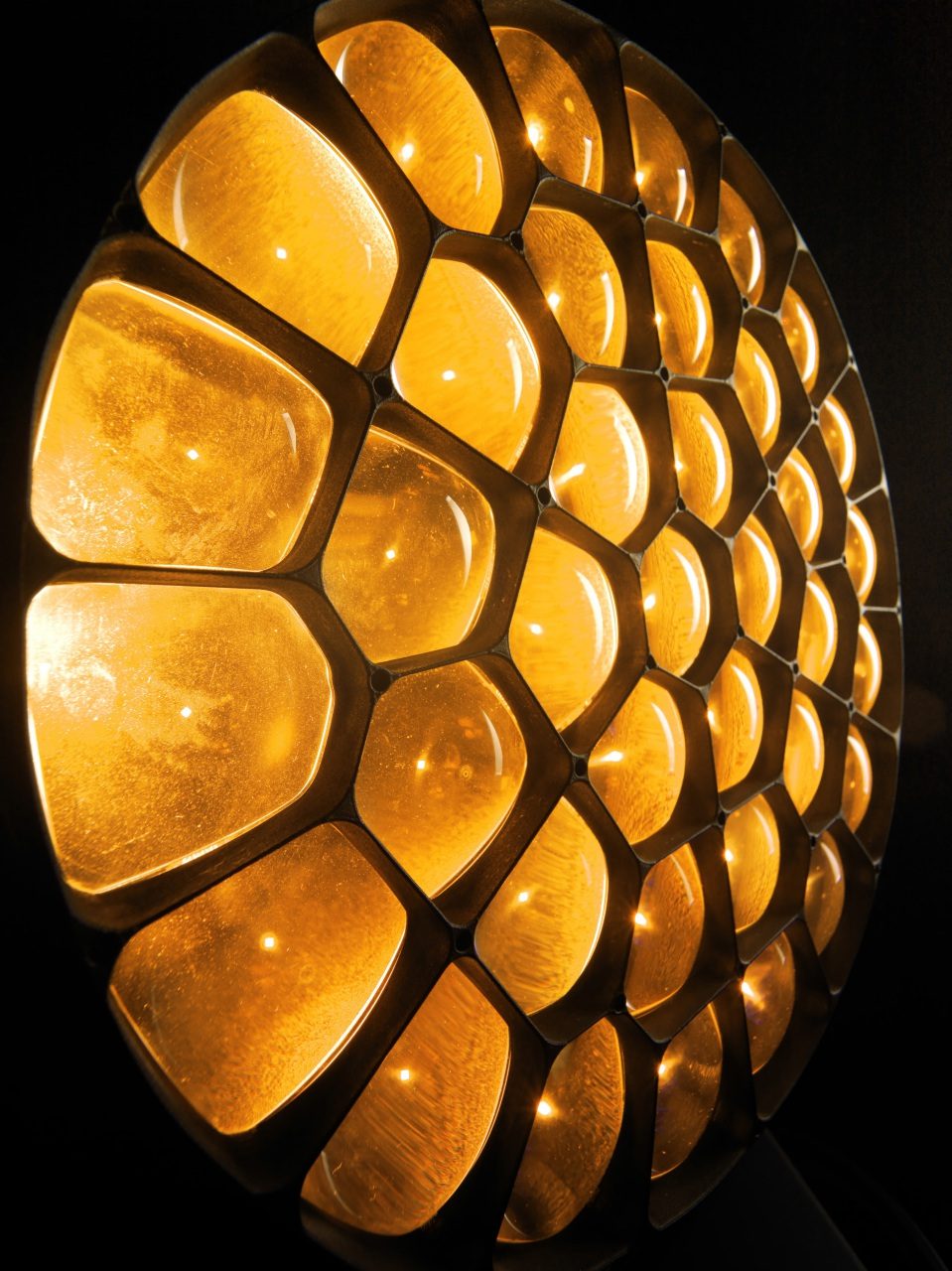
As Pio Nahum, Claypaky’s Sales Director, explained during the demo, the company’s constant experimenting led to a new dimension of movement on top of pan and tilt: rotating the optical system around the axis of the source. The angle of reflection and refraction at which the light hits the lens keeps changing, which creates a cyclical kaleidoscope effect.
And that’s not all. There are three ways to create a dynamic effect:
- the lens stays still and the movement comes from the effect;
- the effect stays still and the movement comes from the rotating lens;
- both move together.
CTO and white balance
Another important feature is white balance control. This DMX channel becomes the RGB reference for the whole B-EYE. If a show is going to be shot on camera, you simply set the right colour temperature and every scene in the show follows it automatically.
Weight and speed
The K20 weighs about 20 kg. There is also a K10 with the same features but without the rotating LED cluster. Speed is excellent as well: the K10 moves about as fast as a Sharpy.
So, what kind of fixture is the B-EYE?

It is a Wash 2.0, evolved and able to go over the top thanks to everything described above. It is very flexible: you can use it as a backlight, as an effect, for pixel mapping, in architectural lighting and, why not, as a front light (not a replacement for conventionals, but usable in many situations).
Now it’s time to use it. Everyone, Claypaky included, wants to see it at work, driven by the imagination of lighting designers around the world. We’ll start seeing the B-EYE on stage in 2014, when it goes into production and distribution.